


Warning
Problem: The current name of your GitHub Pages repository ("Solution: Please consider renaming the repository to "
http://".
However, if the current repository name is intended, you can ignore this message by removing "{% include widgets/debug_repo_name.html %}" in index.html.
Action required
Problem: The current root path of this site is "baseurl ("_config.yml.
Solution: Please set the
baseurl in _config.yml to "Education
-
-
-
 ShenZhen UniversityB.Eng. in Electronics and Information EngineeringSep. 2022 - Jul. 2026
-
-
-
-
-
 National University of SingaporeM.Sc. in Electrical and Computer EngineeringAug. 2026 - JUL. 2027
Honors & Awards
-
Chinese Mathematics Competition, Third Prize2024
-
Greater Bay Area Data Application and Innovation Competition, Third Prize2024
-
Shenzhen University First-Class Academic Scholarship (Top 1%)2024
-
Shenzhen University Second-Class Academic Scholarship (Top 3%)2025 & 2023
-
Shenzhen University Second-Class Innovation and Entrepreneurship Scholarship (Top 3%)2025
-
Shenzhen University Outstanding Graduate & Bachelor's Degree with Honours2026
Internships
-
 The Smart City Research Institute of China Electronics Technology CorporationResearch Assistant InternShenzhen, ChinaNov 2024 - May 2025
- Optimized table recognition model using YOLO, OpenCV, and OCR; performed table detection, region cropping, structural parsing, cell extraction, and text recognition, converting image-based tables into editable files and reducing manual data entry.
- Developed a financial data QA system by cleaning and standardizing historical financial data and importing it into a MySQL relational database. Implemented a rule- and BERT-based approach for user query intent classification and key entity extraction, mapping parsed queries to SQL templates for database retrieval and converting results into natural language responses.
- Engineered an LLM-based intelligent security situational awareness system by performing deep semantic analysis and intent recognition on cross-domain heterogeneous logs. Designed expert-level prompt engineering and few-shot learning strategies to address security identification and real-time response challenges in complex scenarios.
Selected Publications (view all )
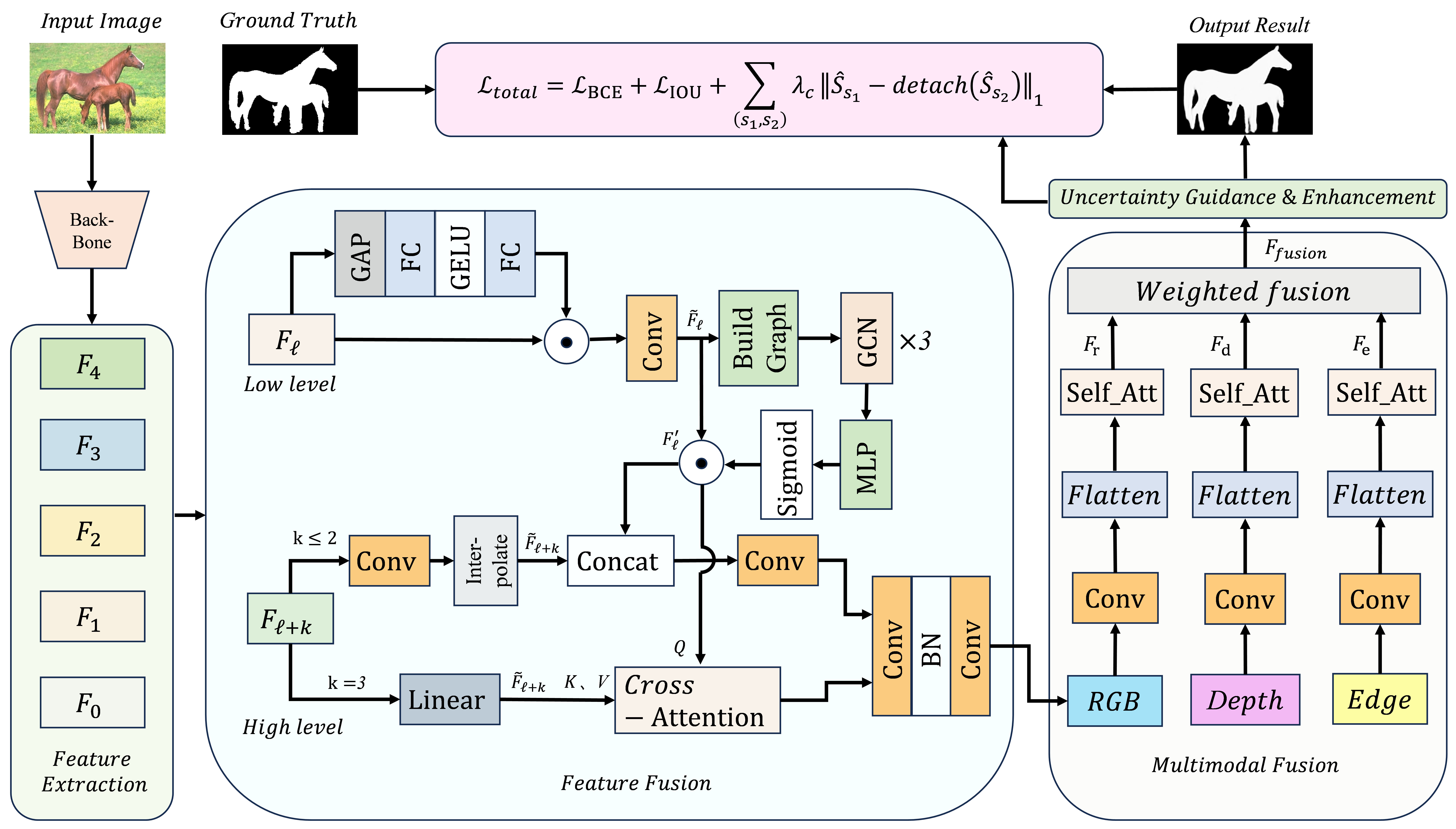
Graph-Based Uncertainty Modeling and Multimodal Fusion for Salient Object Detection
Yuqi Xiong, Wuzhen Shi, Yang Wen, Ruhan Liu
International Conference on Neural Information Processing (ICONIP) 2025
This project focuses on salient object detection in complex scenes, where we developed a dynamic uncertainty-aware graph convolution module to enhance the detection of fine structures and edge regions, addressing detail loss and blurred boundaries. We further designed a multimodal fusion strategy to adaptively integrate RGB, depth, and edge features, enabling cross-modal semantic complementarity and consistency. Experiments on standard datasets demonstrated improved edge clarity and robustness against complex backgrounds.
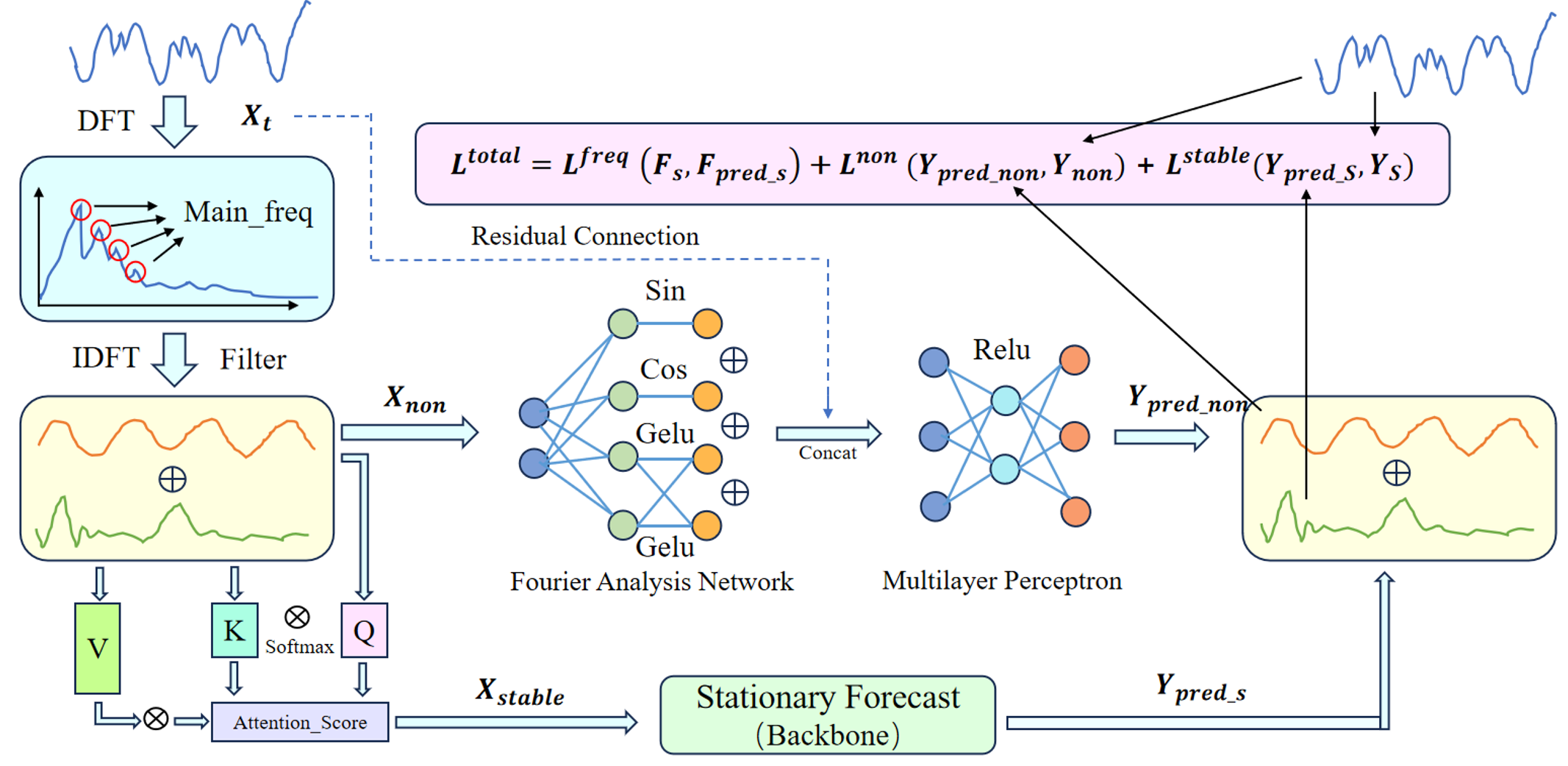
Non-Stationary Time Series Forecasting Based on Fourier Analysis and Cross Attention Mechanism
Yuqi Xiong, Yang Wen
International Joint Conference on Neural Networks (IJCNN) 2025
Proposed AEFIN, a novel framework for non-stationary time series forecasting that combines Fourier Transform-based decomposition to separate stationary and non-stationary components, cross-attention mechanisms for enhanced information sharing, and Fourier analysis for capturing periodic patterns. Designed a custom loss function that integrates MSE and MAE across time- and frequency-domain components to improve model robustness. The proposed framework achieved SOTA performance on most benchmark datasets, consistently improving MSE and MAE when integrated with mainstream Transformer- and CNN-based forecasting models.